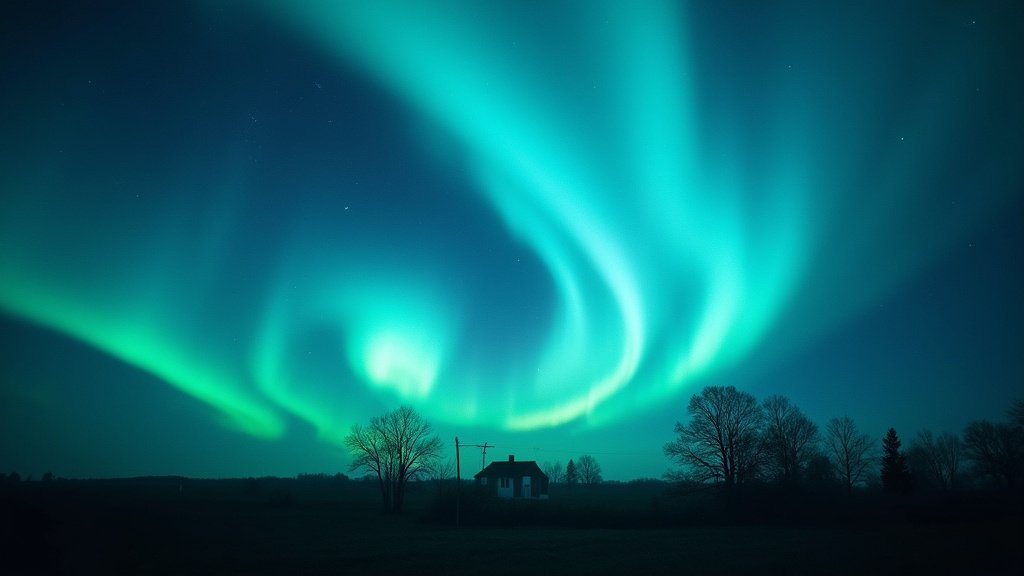
A spectacular display of the Northern Lights, also known as the Aurora Borealis, is expected to be visible much farther south than usual tonight, potentially reaching as far as New York and Idaho. This rare celestial event is due to a significant geomagnetic storm hitting Earth.
Key Highlights:
- A strong geomagnetic storm is predicted to cause widespread auroral displays.
- The Northern Lights may be visible in many northern US states, including New York and Idaho.
- This is a rare opportunity to see the aurora at lower latitudes.
- Experts advise finding a dark location away from city lights for the best viewing experience.
Aurora Alert: Geomagnetic Storm to Illuminate Skies
The Earth is currently experiencing a substantial geomagnetic storm, a phenomenon that occurs when charged particles from the sun interact with our planet’s magnetic field. This interaction excites atmospheric gases, causing them to emit light, which we see as the aurora. Typically, the aurora is confined to polar regions, but the intensity of this storm is expected to push the visible aurora boundaries much further south than usual.
What is a Geomagnetic Storm?
Geomagnetic storms are a type of space weather event that can affect the Earth’s magnetosphere. They are caused by disturbances on the Sun, such as solar flares and coronal mass ejections (CMEs), which release vast amounts of energy and charged particles into space. When these particles reach Earth, they can interact with our planet’s magnetic field, leading to a range of effects, from spectacular auroral displays to disruptions in satellite communications and power grids.
Factors Affecting Visibility
While the geomagnetic storm provides the necessary conditions for the aurora to be visible at lower latitudes, several factors will influence whether individuals can see it. The primary factor is light pollution. To witness the aurora, observers should seek out locations with minimal artificial light, such as rural areas, national parks, or beaches away from urban centers. Cloud cover is another significant obstacle; clear skies are essential for viewing the aurora. The National Oceanic and Atmospheric Administration (NOAA) provides space weather forecasts, including aurora outlooks, which can help individuals determine the best chances of seeing the lights in their region.
Historical Context and Rarity
While auroras are a regular occurrence at high latitudes, sightings at latitudes like New York or Idaho are uncommon. Major geomagnetic storms capable of producing such widespread auroral visibility have occurred throughout history, often becoming significant cultural and scientific events. For instance, the Carrington Event of 1859, the most intense geomagnetic storm on record, caused auroras to be seen as far south as the Caribbean.
The Science Behind the Colors
The captivating colors of the aurora are determined by the type of gas particles being energized and the altitude at which the collision occurs. Oxygen typically produces green and red light, while nitrogen often emits blue and purple hues. The most common color observed is green, which results from oxygen molecules being excited at lower altitudes (around 60-150 miles). Red auroras, also from oxygen, appear at higher altitudes (above 150 miles), while nitrogen can create pink, purple, and blue lights. The dynamic movement and variations in these colors create the mesmerizing dance of light across the night sky.
FAQ: People Also Ask
How often can the Northern Lights be seen in New York?
Sightings of the Northern Lights in New York are rare and depend on significant geomagnetic storm activity. While they are a regular phenomenon in Arctic regions, seeing them at New York’s latitude usually requires a strong to severe space weather event.
What is the difference between the Northern Lights and the Southern Lights?
The Northern Lights (Aurora Borealis) and Southern Lights (Aurora Australis) are essentially the same phenomenon – the aurora. The difference is their location: the Aurora Borealis occurs in the Northern Hemisphere, and the Aurora Australis occurs in the Southern Hemisphere, both near the magnetic poles.
Can geomagnetic storms affect technology?
Yes, intense geomagnetic storms can significantly impact technology. They can induce currents in power grids, leading to blackouts, disrupt satellite operations by damaging electronics or altering their orbits, and interfere with radio communications and GPS signals.
What causes the ‘dancing’ effect of the aurora?
The ‘dancing’ or shimmering effect of the aurora is caused by rapid fluctuations in the Earth’s magnetic field and the flow of charged particles. As the particles interact with the atmosphere, changes in the magnetic field can cause the auroral curtains to shift, ripple, and change in intensity, creating a dynamic and captivating display.
Is it safe to watch the aurora borealis during a geomagnetic storm?
Yes, it is perfectly safe to watch the aurora borealis during a geomagnetic storm. The phenomenon occurs high in the atmosphere, and the charged particles interacting with it pose no direct threat to people on the ground.