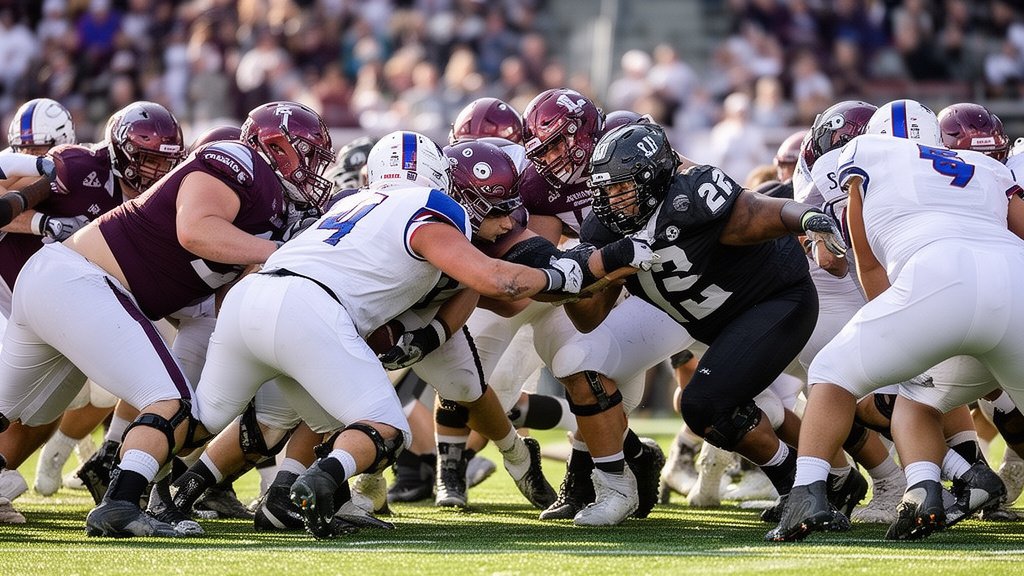
In a display of grit and tactical discipline that defined the landscape of college football on October 17, 2026, the Oregon Ducks managed to stifle the Nebraska Cornhuskers, securing a narrow 17-14 victory in a game that felt like a throwback to an older, more brutal era of the sport. The contest, which saw both offenses struggle to find rhythm, ultimately hinged on Oregon’s defensive front and Nebraska’s inability to adapt to a depleted roster.
The Defensive Grind: Trench Warfare
The narrative of the game was defined in the trenches. Throughout the four quarters, the Oregon defensive front displayed a level of technical prowess that completely neutralized the Nebraska offensive line. By controlling the line of scrimmage, the Ducks successfully dictated the pace of the game, limiting Nebraska to short, inefficient gains that rarely threatened the end zone.
Analysts noted that Oregon’s defensive coordinator implemented a aggressive ‘gap-fill’ scheme that specifically targeted Nebraska’s interior running lanes. This forced Nebraska’s quarterback into passing situations on second and third downs, where the Oregon secondary was waiting with tight, man-to-man coverage. The Ducks’ ability to generate pressure without committing to heavy blitz packages allowed them to maintain a safety shell, ensuring that no deep balls could break the game open for the Cornhuskers. This tactical victory was the deciding factor, as Nebraska’s offense became predictable and stagnant under the mounting pressure.
The Nebraska Run Game: A Strategic Breakdown
For Nebraska, the 17-14 loss serves as a stark wake-up call regarding their offensive identity. Entering the 2026 season, the Cornhuskers had established their identity as a run-first team, a strategy that had yielded success in early-season matchups. However, the game against Oregon exposed the fragility of this plan when faced with an elite, disciplined defensive unit.
Nebraska failed to establish any rhythm on the ground, accumulating their lowest rushing yardage total of the season. The failure was two-fold: the blocking schemes proved too rigid against Oregon’s agile defensive line, and the play-calling failed to adjust when the primary rushing lanes were closed off early in the first half. By the third quarter, the reluctance to integrate creative play-action or RPO (Run-Pass Option) elements meant the Cornhuskers were fighting an uphill battle against a defense that essentially knew what was coming. The lack of versatility proved fatal, as the offense could not sustain drives long enough to rest their own defense, leading to fatigue in the final minutes of the game.
Injury Woes and the Path Forward
Beyond the scoreboard, the most significant long-term consequence of the October 17 clash is the mounting injury report for the Cornhuskers. Two key offensive starters were forced to leave the field in the first half, and their absences were glaringly obvious as the game progressed. The depth of the Nebraska roster, previously touted as a strength by coaching staff, was put to the test and, in this instance, came up short.
Sports medicine analysts looking at the game film have pointed to the intensity of the defensive contact as a primary driver of the injuries. For a team with championship aspirations, the ability to ‘next-man-up’ is non-negotiable. The coaching staff now faces a critical week of adjustments. They must determine how to bridge the gap in talent while waiting for starters to return to full health, or fundamentally pivot their offensive scheme to accommodate a different personnel grouping. The injury situation is not just a health concern; it is a strategic roadblock that will likely force Nebraska to play more conservatively in the coming weeks.
The Future Outlook: What This Means for the Conference
The 17-14 result fundamentally shifts the power dynamics in the conference. Oregon has now cemented itself as a legitimate contender capable of winning low-scoring, defensive battles, a trait that is essential for deep postseason runs. Meanwhile, Nebraska must use this loss as a foundational learning experience. The path to recovery involves simplifying their protection schemes to account for missing personnel and diversifying their rushing attack to ensure they aren’t one-dimensional.
As the season progresses, both teams will look back at this game as a pivot point. For Oregon, it is a testament to the efficacy of their defensive philosophy. For Nebraska, it is a challenge to their resilience and adaptability. As the calendar moves toward November, the questions raised in this 17-14 slugfest will dictate whether these teams continue to ascend or fall behind in the conference standings.
FAQ: People Also Ask
Why was the Nebraska offense so stagnant throughout the game?
Nebraska struggled primarily due to Oregon’s disciplined defensive front, which successfully closed gaps and neutralized the Cornhuskers’ run-first identity. The lack of mid-game adjustments meant Nebraska continued to run into a ‘stacked box,’ resulting in minimal gains and forced passing situations that played into Oregon’s hands.
What is the severity of the injuries Nebraska sustained?
While official reports are pending further evaluation, the loss of two key offensive starters significantly disrupted Nebraska’s rhythm. The team’s ability to remain competitive in the coming weeks will depend heavily on the recovery timeline of these players and the effectiveness of the backup rotation.
Does this 17-14 loss eliminate Nebraska from conference title contention?
Not entirely. While the loss is a setback, the nature of the conference schedule in 2026 means that Nebraska still controls its own destiny to an extent. However, they can no longer afford to rely on a one-dimensional game plan if they hope to secure a high seed in the postseason.