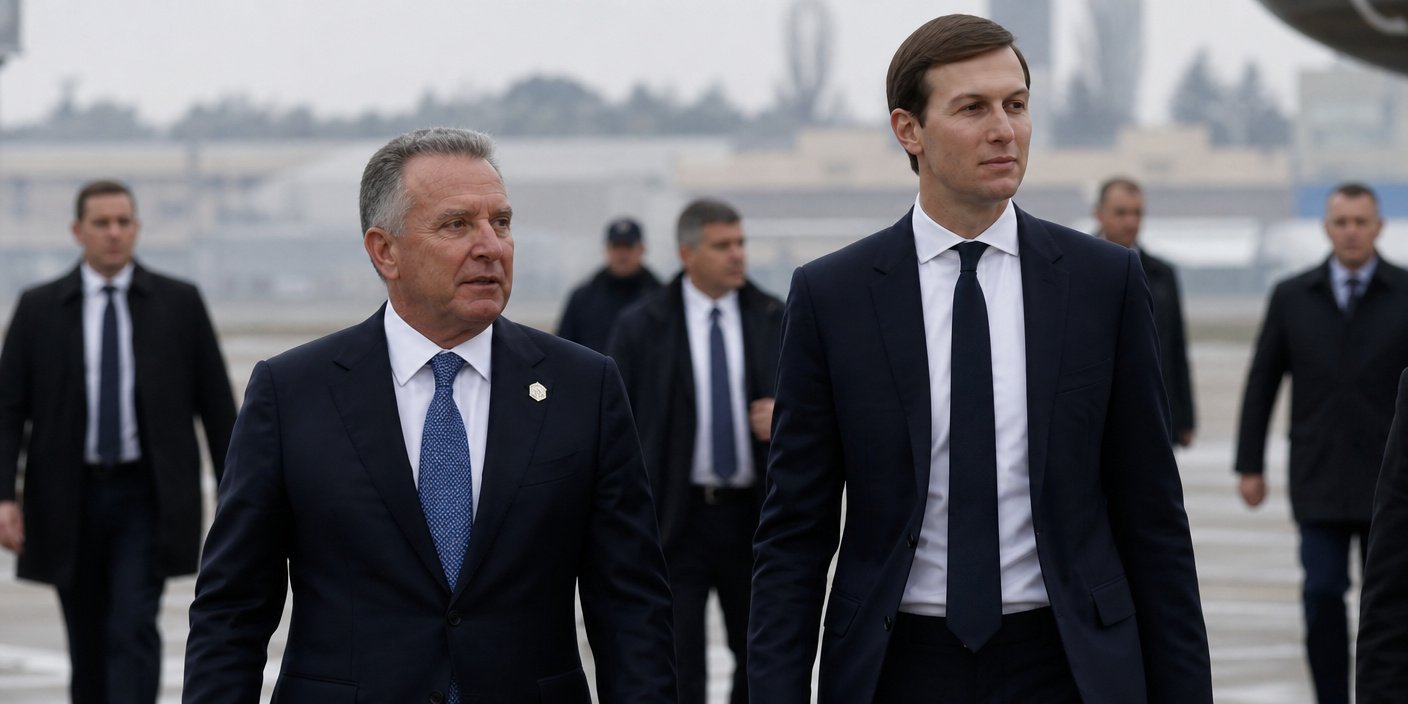
U.S. presidential envoys Steve Witkoff and Jared Kushner have officially landed in Kyiv to coordinate on renewed peace efforts, marking a critical transition in their diplomatic mission following a substantive three-hour meeting with Russian President Vladimir Putin in Moscow. The visit to the Ukrainian capital represents a high-stakes attempt to break the diplomatic stalemate that has paralyzed progress toward a ceasefire and long-term resolution in the ongoing conflict.
Key Highlights
- Diplomatic Shuttle: Envoys Steve Witkoff and Jared Kushner traveled directly from Moscow to Kyiv following a three-hour engagement with President Putin.
- Core Mission: The primary objective is to revive stalled peace talks and explore potential pathways for de-escalation.
- High-Level Access: The duration and direct nature of the Moscow meeting indicate a prioritized focus on direct, high-level diplomatic channel engagement.
- Strategic Transition: This mission signals a shift toward a more aggressive, direct-negotiation strategy adopted by the U.S. presidential administration.
The Moscow-Kyiv Diplomatic Pivot
The arrival of Steve Witkoff and Jared Kushner in Kyiv follows an intense period of behind-the-scenes maneuvering that culminated in a three-hour summit in Moscow. By engaging directly with the Kremlin, the envoy team has positioned themselves at the center of a complex diplomatic puzzle. This movement from Moscow to Kyiv is not merely a logistical flight plan; it is a clear signal that the U.S. intends to act as a primary broker, facilitating communication where traditional diplomatic channels have effectively frozen.
The Mechanics of the Moscow Summit
Details emerging from the Moscow engagement suggest the conversation was granular rather than ceremonial. A three-hour duration for a meeting with a head of state of Russia’s stature implies that the discussion went beyond pleasantries, likely diving into the specific conditions each side requires to return to the negotiating table. For the Trump administration’s team, the goal is to identify the friction points—whether they relate to territorial demarcation, security guarantees, or sanctions relief—and test the feasibility of a framework that both parties might be willing to discuss. This is a classic “shuttle diplomacy” approach, popularized in the 20th century but adapted here for the digital age where speed and direct access are paramount.
Challenges in the Kyiv Corridor
Upon arriving in Kyiv, the pressure on Witkoff and Kushner shifts from listening to brokering. The Ukrainian leadership has long maintained a position of strategic autonomy, demanding that any peace process respect their sovereign boundaries and security requirements. The envoys face the arduous task of presenting the findings from their Moscow meeting without appearing to have conceded ground or compromised the interests of the Ukrainian state. This requires a delicate balance. If they bring back proposals that are perceived as too favorable to the Kremlin, they risk alienating their hosts in Kyiv. If they bring back demands that the Kremlin will not entertain, the mission stalls before it begins.
The Role of Private Envoys in Modern Foreign Policy
The utilization of private envoys—individuals like Witkoff and Kushner who operate outside the traditional State Department hierarchy—is a deliberate strategic choice by the current administration. By eschewing the traditional bureaucracy, the administration seeks to achieve two things: deniability and speed. This model operates on the belief that career diplomats are often constrained by institutional inertia and protocol. In contrast, the Witkoff-Kushner team operates as a direct conduit to the executive power center, allowing for rapid decision-making. However, this also introduces risks. Critics argue that the lack of institutional oversight can lead to inconsistencies or misunderstandings that may complicate longer-term foreign policy objectives. Yet, proponents maintain that in a crisis where the status quo has failed to produce results, the risk of unconventional diplomacy is a price worth paying for the possibility of a breakthrough.
Assessing the Potential for De-escalation
Can this mission actually lead to a reduction in hostilities? The history of this conflict is littered with failed summits and discarded peace plans. However, the unique timing of this mission—following a direct, prolonged conversation in Moscow—suggests that all parties may be reaching a point of “strategic exhaustion.” Both sides have expended massive economic and political capital over the last few years. If the Witkoff-Kushner mission can find the narrow overlap where the interests of Moscow and Kyiv intersect with the global economic need for stability, the possibility of a preliminary ceasefire could move from theoretical to actionable.
FAQ: People Also Ask
1. What is the primary goal of the Witkoff-Kushner mission?
The primary goal is to assess the potential for reviving stalled peace negotiations and to establish a direct, high-level diplomatic channel to facilitate potential future discussions between Russia and Ukraine.
2. Why did the envoys meet with Vladimir Putin in Moscow first?
Meeting with the Russian head of state first allowed the envoys to understand the Kremlin’s current negotiating stance and “red lines” before presenting those findings to officials in Kyiv, aiming to find realistic common ground.
3. How does this mission differ from traditional State Department diplomacy?
Unlike traditional diplomacy, which relies on long-standing diplomatic corps, hierarchical clearance, and established protocol, this mission relies on a smaller, agile team with a direct line to executive leadership, designed for speed and unconventional negotiation tactics.
4. Is there a timeline for these peace efforts?
While no formal deadline has been made public, the urgency of the mission—traveling immediately from Moscow to Kyiv—suggests that the administration is operating on an accelerated timeline to produce tangible progress in the near term.