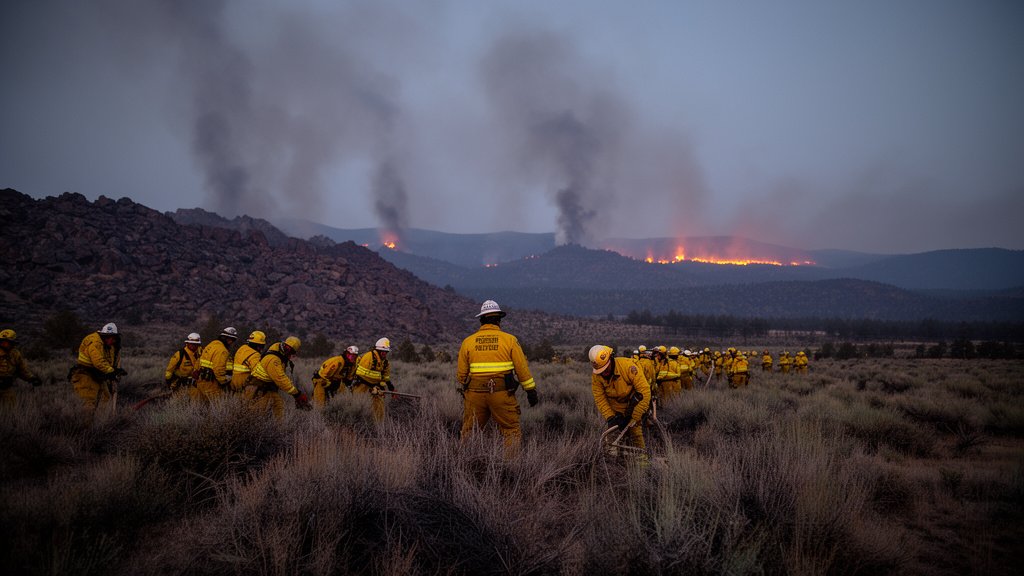
The atmosphere over Central Oregon transformed into a crucible of ignition this week as an intense, dry thunderstorm system tracked across the high desert, delivering a barrage of nearly 2,000 lightning strikes in a single operational period. By Wednesday evening, the landscape was pockmarked with over 35 reported wildfires, forcing fire management agencies into a full-scale defensive posture. This rapid escalation has pushed the regional wildfire response infrastructure to its capacity, forcing officials to make harrowing tactical decisions regarding resource allocation and structure protection as unpredictable, wind-driven fire behavior continues to challenge containment efforts across the region.
Key Highlights
- Unprecedented Activity: A single storm system produced approximately 2,000 lightning strikes, resulting in a sudden surge of 35+ active wildfire starts.
- Tactical Prioritization: Fire crews are operating under a rigorous triage system, prioritizing the defense of residential structures and critical infrastructure over deep-wilderness suppression.
- Meteorological Threat: Persistent, erratic wind gusts are complicating containment efforts, causing fire fronts to shift direction rapidly and threatening to merge smaller lightning-sparked fires.
- Multi-Agency Response: Coordination between the Central Oregon Fire Management Service (COFMS), the Bureau of Land Management (BLM), and local fire districts is central to the containment strategy.
The Siege of Sparks: Navigating the Central Oregon Wildfire Crisis
The arrival of a high-energy, dry-lightning storm system has brought the issue of Central Oregon wildfire vulnerability into sharp focus. For land managers, the challenge is not merely the number of ignitions, but the geographic dispersion of the fire starts. When a single meteorological event generates 2,000 strikes across a rugged, often inaccessible landscape, the initial response is inevitably stretched thin. This event serves as a stark reminder of the volatile nature of the High Desert during peak summer months, where the intersection of low fuel moisture and high electrical activity creates a perfect storm for rapid fire spread.
The Mechanics of the Lightning Siege
Unlike frontal systems that bring soaking rain to suppress ignitions, the recent thunderstorm complex was characterized by extreme heat and erratic downdrafts. These conditions are conducive to ‘holdover fires’—ignitions that smolder in deep root systems or duff for hours, or even days, before winds carry them into the crown of the forest. The sheer volume of lightning strikes makes the initial detection phase the most critical element of the response. Using a mix of fire lookout towers and high-altitude aerial reconnaissance, the Central Oregon Fire Management Service (COFMS) has had to identify which of the 35+ reports pose an immediate threat to the Wildland-Urban Interface (WUI) and which can be monitored or managed through indirect suppression tactics. This detection-to-suppression timeline is the primary metric by which the safety of local communities is measured.
Tactical Prioritization and the Incident Command System
When faced with more ignitions than resources, the Incident Command System (ICS) dictates a rigid hierarchy of values at risk. First and foremost, the focus is on life safety—not only for the fire crews but for residents in potential path-of-travel zones. Second is the protection of permanent structures and private property. Only after these two priorities are secured can teams turn their attention to suppressing fires in remote or roadless areas.
This strategy is often misunderstood by the public, who may see smoke columns rising in the distance while crews appear to be ‘doing nothing’ in their vicinity. In reality, these crews are often strategically positioned at the perimeter of the nearest residential development, clearing defensible space and conducting burn-out operations to deny the fire the fuel it needs to advance. The integration of local fire districts with federal land management agencies is the linchpin of this effort, allowing for the sharing of specialized resources like heavy air tankers and hand crews across jurisdictional boundaries.
Economic and Community Ripples
The economic impact of a mid-summer fire siege is profound. Beyond the direct costs of suppression—which can run into the millions daily for major incidents—the disruption to the local economy, particularly tourism and outdoor recreation, is immediate. Evacuation orders, even temporary ones, destabilize local supply chains and place immense stress on community morale. Furthermore, the psychological toll on residents in areas prone to annual fire threats cannot be overstated. The uncertainty caused by the ‘lightning siege’ model of wildfire ignition means that homeowners are constantly balancing the need for fire-resistant landscaping with the reality of living in a landscape that is historically fire-adapted.
Climate Context and Future Vulnerability
Looking ahead, scientists warn that these high-lightning events are becoming more frequent in the Pacific Northwest. The phenomenon is linked to broader shifts in climate patterns that favor hotter, drier summers. As the vegetation in the region becomes increasingly ‘stressed’ due to prolonged drought conditions, it effectively becomes ‘pre-heated’ fuel. Even moderate lightning activity can trigger high-intensity fires in such conditions.
For residents and policymakers, this new reality necessitates a shift from a reactive to a proactive mindset. The focus is increasingly moving toward ‘community hardening.’ This involves initiatives like the Firewise USA program, which encourages neighborhoods to reduce hazardous fuels within 100 feet of their homes. While firefighting crews can manage the perimeter, the resilience of a home during a wildfire event is often determined by the condition of the property itself before the first ember lands.
FAQ: People Also Ask
Q: Why are there so many wildfires after a storm?
A: Many thunderstorms in the region are ‘dry,’ meaning they produce lightning but very little precipitation. A single bolt of lightning carries immense energy capable of igniting dry organic matter, which can smolder for hours before erupting into a flame.
Q: How do fire crews prioritize which fires to fight first?
A: Agencies use a triage system based on ‘values at risk.’ This prioritizes human life and residential structures above all else, followed by critical infrastructure like power lines and water treatment facilities, and finally wilderness habitat.
Q: What is the ‘Wildland-Urban Interface’ (WUI)?
A: The WUI is the zone where human development—homes and infrastructure—meets or intermingles with undeveloped wildland vegetation. This area is the highest priority for fire management because of the potential for property loss and threats to human life.
Q: Can homeowners help prevent these disasters?
A: Yes, by creating ‘defensible space.’ This involves thinning trees, clearing dead brush, and removing flammable materials from around the home to give firefighters a better chance of protecting the structure when a fire approaches.