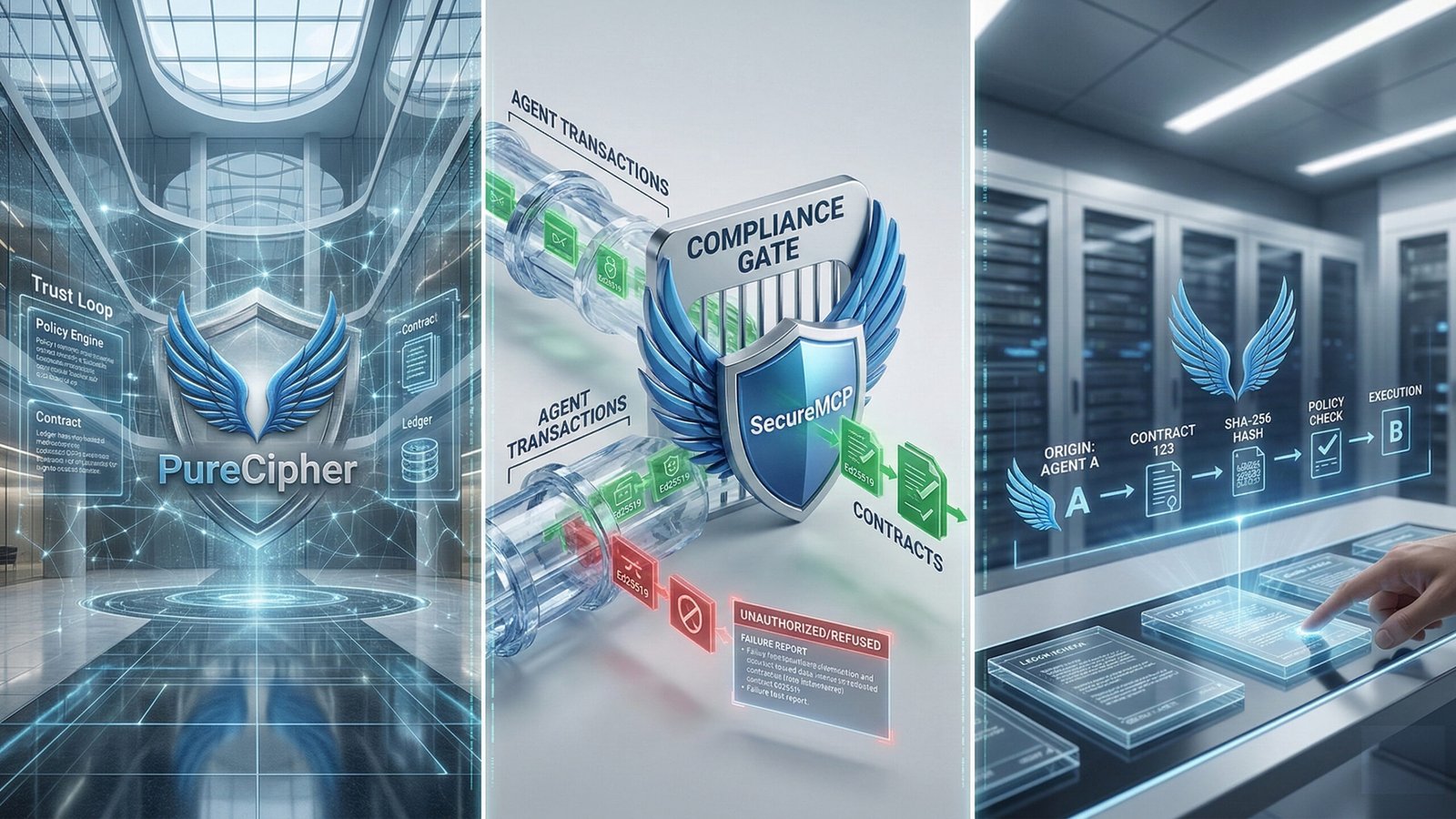
The global economy is on the precipice of a transformation so profound that it has been described as Economics 2.0, representing a leap from human-led commerce to a world where machines conduct business with other machines. Today, human-initiated transactions still dominate our world, accounting for roughly 9.3 billion daily exchanges and 4.9 trillion dollars of value. However, PureCipher, a pioneer in AI security and data integrity, forecasts a monumental shift within the next five years: the rise of the Agentic Economy.
In this imminent future, agent-to-agent transactions are expected to skyrocket to 5 trillion transactions per day, settling nearly 4 trillion dollars in value. The A2A transactions include money moved on behalf of humans, ASR calls, web fetches, code runs, image/Excel generation, and database writes, each counted as a transaction. These figures are not mere speculation; they are a matter of mathematics. With a projected population of 1.5 trillion agents serving 3 billion users (averaging 500 agents per user), and a transaction latency of roughly 50 milliseconds, even a tiny fraction of active agents can generate trillions of data fetches, code runs, and financial settlements daily.
Specifically, if only 0.002% of these agents are active at any instant and average 2 tx/sec, it yields 5.2 trillion transactions per day. Because many calls are cacheable or read-heavy, an average cost of $0.005/tx keeps the daily spend in the low tens of billions, a figure that is realistic relative to global IT and cloud spend.
The critical question facing this new economy is one of trust. When agents operate at such massive scale and speed, how can we ensure they remain lawful, compliant, and secure? To address this, PureCipher has unveiled SecureMCP, a groundbreaking extension of the Model Context Protocol designed to serve as the missing trust layer for the agentic world.
From Opaque Execution to Verifiable Trust
Traditional AI runtimes are often opaque executors where you give a command and the machine performs it in a black box. SecureMCP changes this paradigm by transforming these runtimes into cryptographically verifiable trust fabrics. By implementing SecureMCP atop FASTMCP, PureCipher provides machine-verifiable guarantees of lawful execution, non-repudiation, and tamper-evident provenance.
This integration is essential for the adoption of AI agents in high-stakes domains such as healthcare, finance, and industrial IoT, where a single error or unauthorized action can have catastrophic consequences.
The Five Pillars of the SecureMCP Trust Loop
SecureMCP achieves its security through five tightly coupled modules that form a continuous Trust Loop. These modules ensure that every action is checked before, during, and after it occurs:
- Pluggable Policy Engine: This module acts as the digital gatekeeper by dynamically enforcing machine-checkable rules, such as role-based access and the minimum necessary principle, to validate every request before it is processed.
- Inter-Agent Contract Module: Agreements between agents are encoded into digitally signed, non-repudiable commitments with explicit lifecycles.
- Provenance Ledger: Every decision, action, and data flow is anchored in a tamper-evident, hash-linked structure using Merkle proofs to ensure an immutable record of history.
- Reflexive Core: This module provides the system with runtime self-awareness, allowing it to detect anomalies or violations in real time and halt or escalate the situation instantly.
- Federated Consent Graph: This models entities, jurisdictions, and the legal bases for processing by generating cryptographically signed proofs that ensure every action is lawful across borders.
Together, these components create a powerful logic: Policies constrain what may happen; Contracts codify what was agreed; and the Ledger records what did happen. Meanwhile, the Reflexive Core ensures unsafe actions cannot happen, and the Consent Graph ensures only lawful actions can happen.
The Trust Envelope: How a Transaction is Secured
To understand SecureMCP in action, one must look at the Trust Envelope, which is a layered security process applied to every request before any model output is returned to a client.
When an agent initiates a request, the Policy Engine first validates it against organizational and regulatory rules. The Contract Module commits the terms to ensure non-repudiation, while the Provenance Ledger records the request immutably. The Reflexive Core monitors for anomalies, and finally, the Consent Graph validates jurisdictional constraints. Only after these steps is the request passed to the Large Language Model with controlled context. The final inference result is returned to the client annotated with proofs that the process adhered to the trust guarantees of the system.
Compliance-Gated Flow: A Binary for Safety
SecureMCP introduces a compliance-gated flow that ensures nothing unsafe or unlawful can proceed silently. Every request in the system leads to one of two outcomes:
- Approved: The request is recorded immutably, contractually bound, and cryptographically provable.
- Rejected: The request is denied execution, and the violation is logged in the ledger for immediate accountability.
By enforcing this binary outcome, SecureMCP provides a level of machine-verifiable prevention that is entirely absent from standard orchestration frameworks.
Foundations and Future Directions
The power of SecureMCP lies in its composition of widely deployed, robust cryptographic primitives. This includes Ed25519 Signatures to authenticate actors, SHA-256 Hash Chains to ensure tamper-evidence, and Merkle Trees for efficient data verification. These foundations provide a suite of system guarantees, including security, compliance, resilience, auditability, and federation.
Looking ahead, PureCipher is exploring even more advanced frontiers:
- Zero-Knowledge Proofs: Enabling privacy-preserving compliance checks without exposing sensitive data.
- Federated Machine Learning: Enforcing consent-aware training and inference processes.
- Blockchain Integration: Optional use of Hyperledger or Ethereum for decentralized trust backends.
- Advanced Reflexivity: Utilizing machine learning based anomaly detection to extend the self-aware capabilities of the system.
Conclusion: The New Reference Architecture
PureCipher has created the first trust extension for the Model Context Protocol, filling the critical gap of provable trust in the agentic economy. By embedding cryptographic verification and reflexive monitoring directly into the control plane, SecureMCP stands as the reference architecture for secure, compliant, and self-aware multi-agent systems.
As we move toward a trillion-agent economy, PureCipher remains committed to protecting national interests and individual sovereignty through technologies that are not just intelligent, but fundamentally trustworthy.
FAQ: Understanding SecureMCP and the Agentic Economy
What exactly is the “Agentic Economy”?
The Agentic Economy represents a shift where AI agents conduct the majority of digital transactions, such as data fetching, financial settlements, and code execution, on behalf of humans. Experts predict this will account for 5 trillion transactions daily within five years.
Why do we need SecureMCP if we already have the Model Context Protocol?
While the protocol provides a standard for how agents interoperate, it lacks a native layer for provable trust. SecureMCP fills this gap by embedding cryptographic verification and real-time governance directly into the agent runtime.
How does SecureMCP prevent unauthorized actions?
It uses a Trust Loop consisting of a Policy Engine and a Reflexive Core. The Policy Engine checks every request against rules before it happens, while the Reflexive Core monitors the system in real time to halt any anomalous or unsafe behavior.
Is my data safe and tamper-proof within this system?
Yes. Every action is recorded in a Provenance Ledger using SHA-256 hash chains and Merkle trees. This creates a tamper-evident, immutable record of every decision and data flow, making unauthorized changes detectable.
What industries benefit most from SecureMCP?
SecureMCP is essential for high-assurance domains where compliance and safety are critical, specifically healthcare, finance, and industrial IoT.
How does PureCipher handle legal compliance across different countries?
It utilizes a Federated Consent Graph. This module models different legal jurisdictions and user permissions to ensure that every agent action is backed by a cryptographically signed proof of lawful processing.