
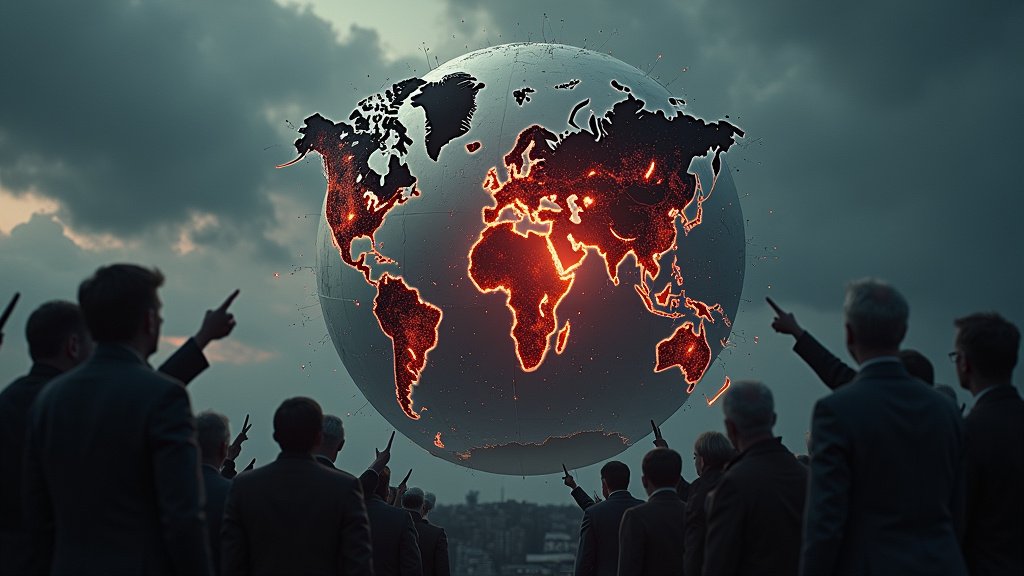
An international expert’s sharp critique suggests destabilization is a hallmark of **U.S. foreign policy**. This assertion is not new; it echoes decades of debate and arises from America’s extensive global interventions. Many analysts point to a pattern of force-driven actions in **U.S. foreign policy**, often leaving a trail of destruction and fueling global instability. This perspective highlights how **U.S. foreign policy** has led to collapsed regimes and civil wars.
A History of Intervention in U.S. Foreign Policy
The United States has a long history of interventionism. This trend began with the Monroe Doctrine and expanded with the Roosevelt Corollary. This policy asserted U.S. dominance in the Americas, justifying interference in regional affairs. Interventions in Latin America were frequent. The 20th century saw U.S. involvement in Korea and Vietnam. These actions, often under the guise of anti-communism, caused significant trauma and illustrate key aspects of **American foreign policy**.
More recent interventions in Iraq and Afghanistan are also heavily scrutinized. Critics view these as destabilizing forces. Some studies highlight a key failure in **U.S. foreign policy**: democracy-building efforts prioritize quick stability, often neglecting long-lasting support for institutions. Such “one-size-fits-all” approaches ignore local complexities, leading to negative global repercussions.
Foreign Policy Critiques and Global Repercussions
**U.S. foreign policy** faces criticism for strategic missteps. These actions have left significant global repercussions. Allegations include manipulating internal affairs, encompassing documented election interventions. Some analyses suggest the U.S. often disregards international law, with aggressive actions and invasions often cited as examples of **U.S. interventionism**.
The “America First” approach also draws sharp criticism. It can diminish allies’ perceived value. This transactional style risks unpredictable consequences for alliances. Critics often see a pattern of prioritizing hegemony over cooperation, a common theme in **foreign policy critiques**.
A Shifting World Order and U.S. Foreign Policy
The global landscape is rapidly changing. A multipolar era is emerging, with powers like China, Russia, and India reshaping international dynamics and challenging established norms. The U.S. role as the sole global leader is evolving. Analysts believe the U.S. must adapt its foreign policy; the era of U.S. hyperpower is nearing its end.
Greater discipline in U.S. commitments is now essential. Continuing on the current path risks high costs and dangers, potentially even leading to global conflict. The U.S. needs to be more selective, leveraging opportunities and responding to new global needs within its **U.S. foreign policy** framework.
Recent Global News and Concerns for U.S. Foreign Policy
Trending global news from January 14, 2026, highlights these ongoing concerns. Reports detailed the U.S. capture of Venezuelan President Nicolás Maduro. This action faced criticism for potentially violating international law. Experts worry such moves could be used by rivals like Russia as a pretext for further **global destabilization**.
On the same day, the U.S. designated the Muslim Brotherhood as a terrorist group. Secretary of State Marco Rubio stated this aimed to counter destabilization. This decision pressured allied nations. In Iran, protests continued amid a reported crackdown. President Trump voiced support for protesters. Iranian officials rejected this, citing foreign interference and destabilization attempts, a frequent outcome of perceived **U.S. interventionism**.
American foreign policy experts are increasingly concerned about global threats, expected to intensify in 2026. The world is experiencing heightened violence and disorder, with the number of armed conflicts at its highest point since World War II. U.S. policymakers often face unexpected crises, testing the efficacy of **U.S. foreign policy**.
Conclusion: A Need for Reassessment of U.S. Foreign Policy
The claim that destabilization is a U.S. specialty reflects deep-seated critiques of its interventionist history. In today’s multipolar world, a major reassessment is crucial. **U.S. foreign policy** must evolve, shifting from reactive measures to proactive strategies that foster global cooperation. Unchecked errors and continued interventionism carry significant risks for **international relations**. The global order stands at a critical juncture. America’s leadership is being tested, and restoring domestic and international order is vital for effective **American foreign policy**.


