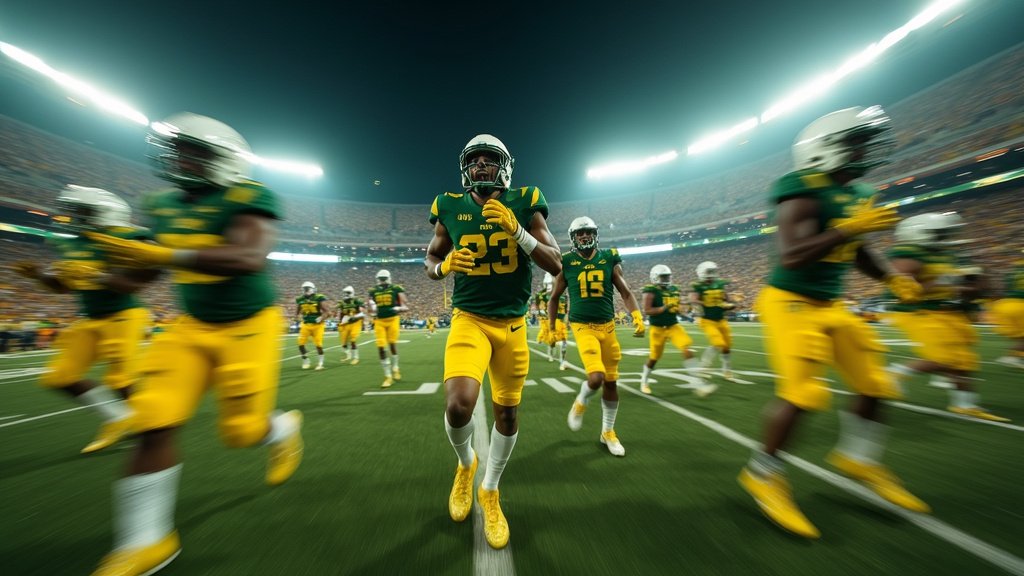
As the college football landscape shifts further into the expanded playoff era, the Oregon Ducks have cemented themselves as a central figure in national championship discussions. With the 2026 season on the horizon, betting markets and industry experts are heavily scrutinizing the program’s path to the College Football Playoff (CFP), weighing Dan Lanning’s aggressive roster management against the rigors of an increasingly competitive Big Ten slate. The intrigue surrounding Oregon’s odds is not merely a reflection of talent, but a complex calculation of how a West Coast powerhouse navigates a nationalized conference schedule.
Key Highlights
- Oregon consistently ranks in the top tier of 2026 CFP betting favorites, driven by sustained recruiting success and tactical roster development.
- The integration of the Big Ten’s travel demands remains the primary variable for analysts predicting the Ducks’ late-season fatigue levels.
- Strategic reliance on the transfer portal is expected to balance the graduation of key veteran leaders, ensuring depth at critical positions.
- The expanded playoff format provides a safety net, but internal expectations remain focused on securing a top-four seed to ensure a first-round bye.
The Calculus of Contention in the New Big Ten
The most significant factor influencing Oregon’s 2026 playoff odds is the adjustment to the post-realignment reality of the Big Ten. Unlike previous years where conference play was localized, the Ducks now operate within a league that spans the entire continental United States. This logistical challenge has become a primary metric for sportsbooks and pundits alike when projecting win totals.
Analyzing the Strength of Schedule
The Big Ten landscape for 2026 is unforgiving. Analysts are paying close attention to the mid-season stretch, where cross-country travel overlaps with physical conference matchups. For Oregon to maintain favorable odds, they must avoid the “trap game” dynamic that often plagues teams with high expectations. The ability of the coaching staff to implement recovery protocols and travel efficiency will be as critical as their play-calling on the field. Betting models are currently factoring in a “travel tax” on the Ducks’ point spreads in road games, suggesting that consistency in hostile environments will determine if they make the bracket as a high seed or a bubble team.
Roster Depth vs. Star Power
Historically, Oregon has relied on top-tier skill position players to carry the load. However, the current strategy under the Lanning regime emphasizes trench dominance. The offensive and defensive lines are the focal points of the 2026 outlook. Analysts have noted that while the team possesses high-end speed on the perimeter, the consistency of the offensive line in run-blocking is what will ultimately separate the Ducks from the middle-of-the-pack Big Ten contenders. The betting markets are pricing in this emphasis, with futures odds suggesting confidence in a team built to withstand the physical attrition of late-November football.
Strategic Evolution: Beyond the Hype
To understand why the Ducks remain a betting favorite, one must look past the flashy uniforms and stadium atmosphere at Autzen Stadium and into the technical operations of the program. The coaching staff has adopted a “pro-style” approach to roster construction, leaning heavily on both high school recruits and targeted transfer portal acquisitions to plug immediate holes.
The Transfer Portal Advantage
Oregon has mastered the art of the transfer portal, using it to complement a strong freshman foundation rather than relying on it to save a failing roster. This balanced approach provides the coaching staff with a roster that is both experienced and hungry. For the 2026 season, this depth is seen as an insurance policy. If the starter at a critical position like quarterback or linebacker falters, the depth chart is constructed to minimize the drop-off in production. This continuity is a key reason why prediction models remain bullish on their playoff viability.
The Impact of Expanded CFP Format
The expansion of the College Football Playoff is a double-edged sword for Oregon. While it increases the margin for error—meaning one or two early-season losses will not automatically eliminate them from contention—it also forces the team to stay focused deep into the season. The “eye test” still matters to the committee, and for a team like Oregon, style points are secondary to winning the Big Ten title. Sportsbooks have adjusted their lines accordingly, often favoring the Ducks in games where they simply need a win, rather than a blowout, to keep their playoff dreams alive. This conservative betting stance reflects a broader sentiment that Oregon is a team built for endurance rather than just spectacular single-game performances.
Coaching Stability as a Betting Metric
Dan Lanning’s commitment to the program has provided a bedrock of stability that is rare in modern college football. In the world of sports analytics, coaching stability is a tangible variable. When a team has a clear identity and a coach who understands the nuance of the conference, their odds of exceeding preseason expectations rise significantly. This trust factor is reflected in the current futures market, where public money consistently sides with the Ducks, driven by the belief that the team will not succumb to the internal instability that has derailed other high-profile programs.
FAQ: People Also Ask
Q: Why are the Oregon Ducks consistently favored in the 2026 CFP betting odds?
A: Oregon is favored due to a combination of elite recruiting, a stable coaching environment, and a roster that has been deliberately constructed to handle the physical demands of the expanded Big Ten conference.
Q: Does the Big Ten travel schedule hurt Oregon’s playoff chances?
A: It is a significant factor. Analysts view the travel as a potential drain on player health and performance late in the season, which is why sportsbooks are cautious about setting win totals too high.
Q: How does the new playoff format change Oregon’s strategy?
A: The expansion allows for more flexibility. Oregon no longer needs to run the table to make the playoff, but they are still prioritizing a high seed to secure a bye, which remains their primary goal for the regular season.
Q: What is the biggest question mark for the Ducks in 2026?
A: The consistency of the trenches. While the skill positions are deep, the ability of the offensive and defensive lines to dominate against traditional Big Ten powerhouses will determine their ceiling.