As Treasury Secretary-designate Scott Bessent prepares to launch an aggressive “economic D-Day” initiative designed to systematically dismantle Iran’s financial architecture, the Iranian Foreign Ministry has issued a severe ultimatum, warning that any nation facilitating these coercive measures will be treated as a direct participant in an “act of war.” This rhetoric signals a significant escalation in the standoff between Washington and Tehran, threatening to destabilize global energy markets and disrupt diplomatic channels that have remained precarious for years.
Key Highlights
- The ‘Economic D-Day’ Doctrine: Scott Bessent’s strategy focuses on a multifaceted assault on Iran’s revenue streams, specifically targeting illicit oil sales and bypassing financial institutions that facilitate Iranian trade.
- The ‘Act of War’ Threshold: Iran has formally warned the international community that compliance with new U.S. sanctions will be viewed not as economic policy, but as an active involvement in hostilities against the Islamic Republic.
- Strategic Asymmetry: The U.S. approach aims to leverage dollar-dominance and SWIFT exclusion, while Iran threatens to utilize its regional proxy networks and control over the Strait of Hormuz in retaliation.
- Escalating Financial Blockade: The administration’s plan targets the “ghost fleet” of tankers used to export Iranian crude, signaling a shift toward more kinetic and interdiction-focused sanctions enforcement.
The Strategic Siege: Dismantling Iran’s Financial Infrastructure
The appointment of Scott Bessent as Treasury Secretary has marked a pivot from passive containment to a more assertive “maximum pressure” methodology. The so-called “Economic D-Day” represents a comprehensive attempt to sever the lifelines that have sustained the Iranian economy despite existing sanctions. Unlike previous iterations of U.S. sanctions, which often relied on diplomatic signaling or targeted designation of individuals, the current administration’s strategy is rooted in a logistical and technical blockade of Iran’s export capabilities.
The Mechanism of Enforcement
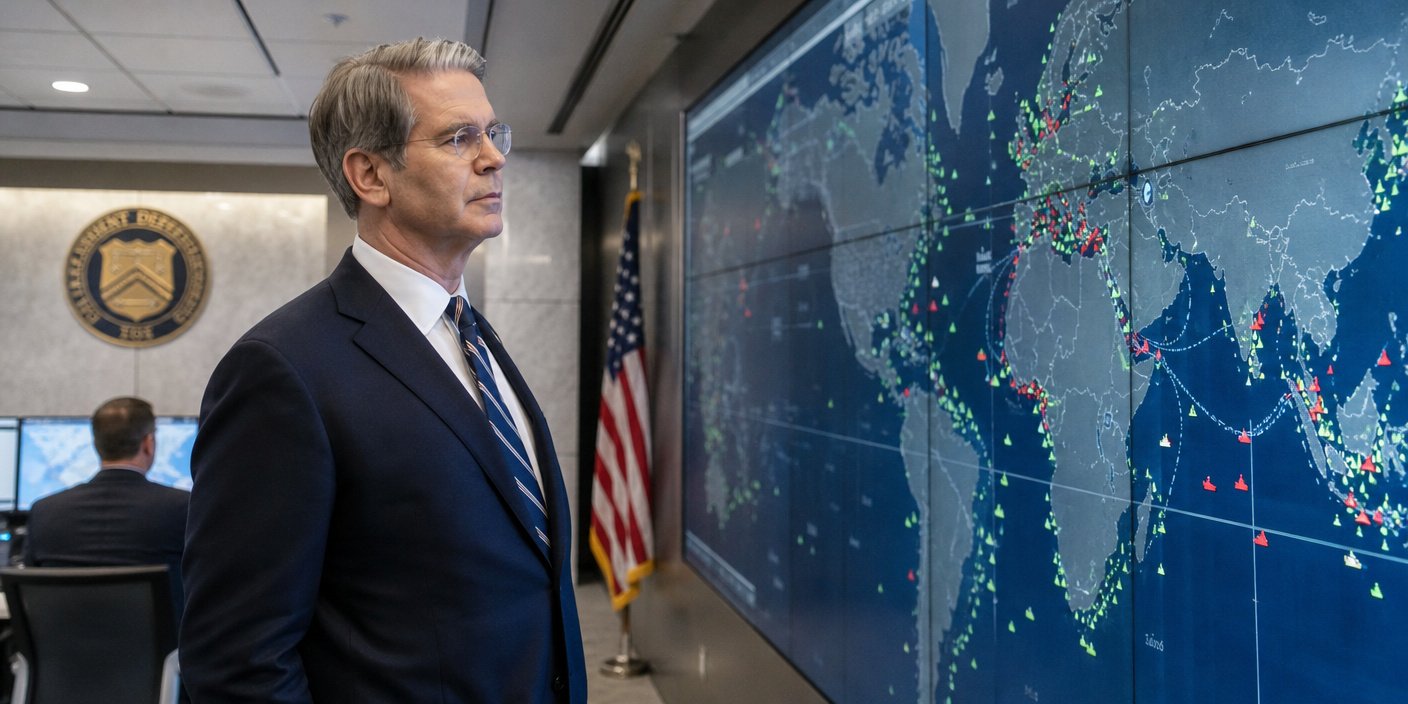
Bessent’s strategy hinges on a dual-track approach: the systematic monitoring of the global “ghost fleet”—a network of repurposed, aging tankers operating in the shadows to transport Iranian oil—and the pressure applied to intermediate financial institutions in third-party nations. By utilizing advanced satellite imagery and marine tracking technology, the Treasury Department intends to identify and sanction vessels that obscure their origin, forcing shipping companies and insurers to choose between access to the U.S. financial system and the lucrative, albeit high-risk, trade with Iran. This creates an existential dilemma for major importers, particularly in the Asian markets, who rely on a steady flow of affordable crude to maintain industrial growth.
Iran’s Diplomatic and Tactical Retaliation
Tehran’s response has been immediate and escalatory. By characterizing the sanctions as an “act of war,” the Iranian Foreign Ministry is expanding the definition of aggression to include economic warfare. This semantic shift is critical; it provides the legal and political justification for Iran to engage in asymmetric responses. Analysts suggest that this could include an increase in proxy operations throughout the Levant and the Arabian Peninsula, or, more significantly, the implementation of more aggressive posturing within the Strait of Hormuz.
Given that approximately 20% of the world’s petroleum consumption passes through this narrow choke point, any increase in volatility could trigger a global supply shock. Iran’s threat suggests that they no longer view economic pressure as a separate track from kinetic conflict. This blurring of lines forces the U.S. to consider the secondary consequences of its financial policy: if sanctions effectively starve the economy, the risk of a regional explosion increases proportionally. The “act of war” declaration is, in effect, a deterrent—a signal that the cost of isolating Iran economically may be paid in regional security stability.
The Global Economic Ripple Effect: A New Calculus
For global markets, the Bessent-led Treasury initiative introduces a period of profound uncertainty. Energy prices, already sensitive to geopolitical tensions, are likely to face upward pressure as the prospect of supply disruptions becomes a tangible variable. The European Union, China, and India—the primary nations caught in the middle—must now recalibrate their foreign policy strategies.
Historically, sanctions enforcement has been a diplomatic game of cat-and-mouse. However, the intensity of this “D-Day” rhetoric suggests a shift toward zero-sum bargaining. The U.S. is betting that its leverage within the global dollar-dominated banking system is absolute, while Iran is betting that its capacity to disrupt the global economy—or its determination to survive isolation—exceeds the West’s appetite for long-term conflict. The next fiscal quarter will be the proving ground for this doctrine. If the U.S. can successfully degrade the Iranian “ghost fleet” without causing a broader kinetic conflict, the policy may be deemed a success. If, however, the threat of an “act of war” translates into maritime incidents or supply chain sabotage, the administration will face a crisis far more complex than simple economic management.
FAQ: People Also Ask
Q: What is the primary goal of the ‘Economic D-Day’ campaign?
A: The campaign seeks to completely isolate Iran’s economy by aggressively targeting oil exports, cutting off access to the international banking system, and penalizing any third-party entity that facilitates Iranian trade.
Q: How does Iran define an ‘act of war’ in this context?
A: Iran interprets the U.S. attempt to fully block its financial lifelines as an illegal violation of sovereignty and an act of economic aggression, implying that supporting these sanctions makes other nations hostile participants.
Q: Will this strategy impact global oil prices?
A: Yes, economists warn that by severely limiting Iranian oil supply and increasing risk premiums in the Strait of Hormuz, the campaign could lead to significant volatility and rising costs in global energy markets.
Q: Who is leading this initiative?
A: U.S. Treasury Secretary Scott Bessent is the primary architect of this strategy, focusing on integrating financial sanctions with intelligence-driven interdiction of illicit trade networks.