At the intersection of precision engineering and marine ecology, Oregon State University’s Chet Udell is pioneering a new form of scientific communication that is as auditory as it is educational. Through his innovative project, “Newport Sonic Tidepools,” Udell, an Assistant Professor (Senior Research) at the OSU College of Engineering, is transforming the Hatfield Marine Science Center into a living soundscape. By utilizing custom-built sensor arrays to capture real-time environmental metrics, Udell converts the rhythmic, often invisible fluctuations of the Pacific Ocean—tide levels, water temperature, and salinity—into immersive audio-visual performances. This initiative is effectively turning the Newport coastline into an interactive data symphony, bridging the chasm between dense scientific research and public accessibility.
Key Highlights
- Interdisciplinary Innovation: Chet Udell, artist-in-residence, integrates electrical engineering with sound design to visualize and audibilize marine data.
- Technological Integration: The “Newport Sonic Tidepools” project relies on custom-built sensor hardware that captures live environmental data, such as tidal currents and salinity levels.
- Public Engagement: The installation at the Hatfield Marine Science Center offers an immersive performance space, allowing the public to “hear” the tidepools, making ecological health feel tangible.
- Educational Impact: The project serves as a model for how citizen science and Maker culture can be utilized in academic research to make complex data more understandable for non-specialists.
The Resonant Coast: Bridging Science and Sound
The fundamental challenge in modern environmental science is not just the collection of data, but the communication of it. Scientists at Oregon State University collect terabytes of information regarding the health of our oceans, but that information often remains trapped in spreadsheets and academic journals. Chet Udell’s work is the antidote to this information silo. His approach, known as data sonification, translates numeric values into auditory frequencies and rhythms. When the tide rises or the water temperature dips, the “Sonic Tidepools” react, producing subtle shifts in the soundscape that mirror these natural events.
The Engineering Behind the Art
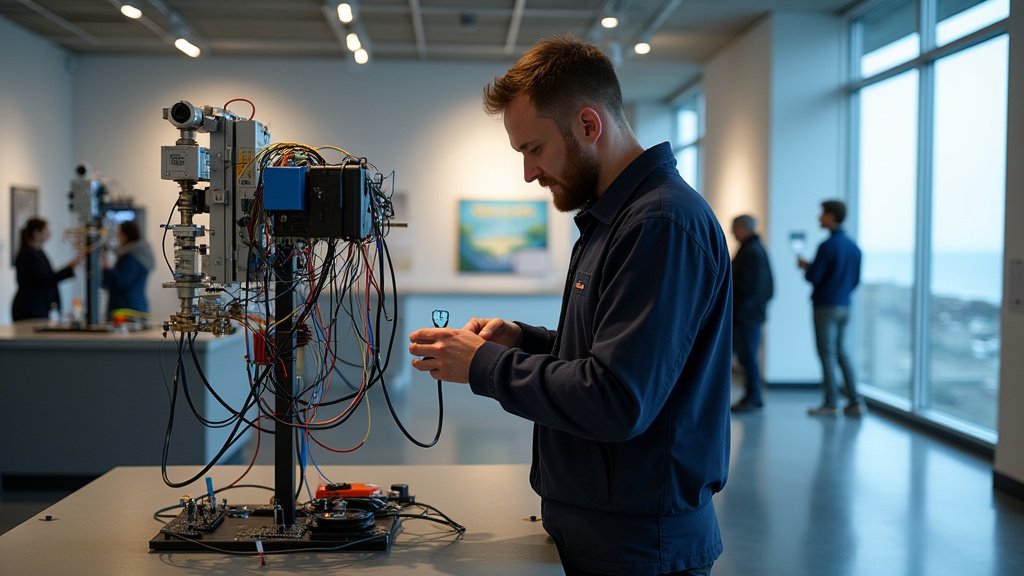
Udell’s instruments are not off-the-shelf laboratory equipment. They are, in many ways, an extension of his expertise in Maker culture and DIY engineering. To create the “Newport Sonic Tidepools,” Udell builds bespoke sensor platforms—utilizing microcontrollers like Arduino and Raspberry Pi—which he deploys in various coastal zones. These devices are ruggedized to withstand the harsh, corrosive nature of salt air and high-impact tidal zones.
Inside these small, weather-proof enclosures lie highly sensitive components: thermistors for temperature, conductivity probes for salinity, and pressure sensors for water depth. But the engineering feat lies in the data pipeline. Once the sensors capture the data, it is processed through algorithms written by Udell to generate musical notes and textures in real-time. A rise in salinity might trigger a higher-pitched, resonant harmonic, while a turbulent current might result in a rhythmic, percussion-heavy pattern. This allows the audience to hear the environment reacting to climate conditions before they even see the results on a graph.
The Hatfield Marine Science Center Installation
Located in Newport, Oregon, the Hatfield Marine Science Center serves as the primary hub for this research. The installation is designed to be fully immersive. Unlike a traditional lecture hall where information is presented linearly, the “Sonic Tidepools” installation is a spatial experience. Visitors walk through the center and find themselves enveloped by the ambient sound of the coast, generated by the very water flowing a few hundred yards outside the building. This creates an immediate, visceral connection to the local ecosystem. By bringing this project to Hatfield, Udell has successfully turned the center into an experimental gallery where the boundary between “research station” and “public museum” begins to dissolve.
The Future of Environmental Monitoring
This project represents a shift in how we might monitor environmental change in the coming decades. By making data “audible,” Udell is opening up new channels for public participation. If a coastal community can hear the changes in their local tidepools through a public art installation, they are more likely to notice the subtle, concerning shifts in biodiversity or water quality. It is a form of environmental advocacy that relies on sensory empathy rather than abstract statistics.
Furthermore, Udell’s methods are highly scalable. Because the sensors are custom-built, they are significantly cheaper than industrial-grade meteorological equipment. This “low-cost, high-impact” model allows schools, citizen science groups, and environmental nonprofits to replicate the technology, potentially creating a network of “sonic tidepools” up and down the Pacific coast. This would allow for a crowdsourced approach to collecting ecological data, democratizing the process of scientific observation.
FAQ: People Also Ask
How does ‘sonification’ of data actually work?
Data sonification is the process of mapping data parameters to sound attributes. For example, a dataset point like ‘water temperature’ is mapped to ‘pitch.’ When the temperature goes up, the pitch goes up. It turns abstract numbers into recognizable auditory patterns that humans process much more intuitively than large tables of data.
Is the music generated by Chet Udell’s project entirely random?
No, the project uses generative algorithms that operate within parameters set by the data. The “rhythm” and “melody” are dictated by the environmental conditions, meaning the “music” is a direct reflection of the physical state of the tidepool at that exact moment. It is a collaborative performance between the ecosystem and the software.
Can students or members of the public participate in building these sensors?
Yes, a core tenet of Chet Udell’s work is the democratization of science. Through his workshops and public demonstrations at Hatfield, he encourages a “Maker” mindset, teaching participants how to build their own environmental monitoring devices using accessible, affordable electronic components.