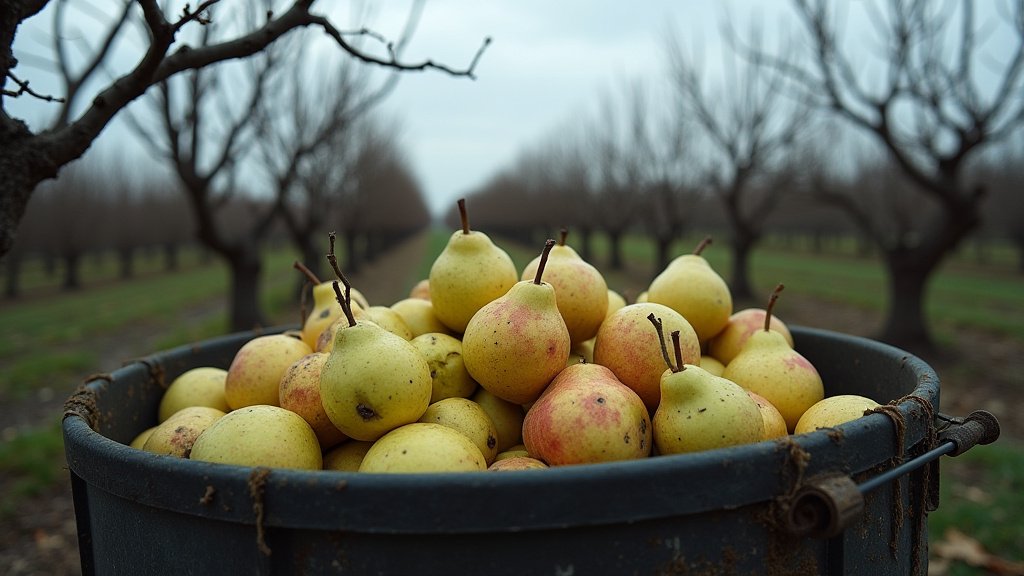
Pear Industry on Brink of Collapse
Economic Storm and Pest Devastation
The Northwest pear industry, a cornerstone of fruit production in Oregon and Washington, is grappling with an existential crisis. Growers are confronting a perfect storm of economic hardship, characterized by alarmingly low fruit prices and the destructive impact of the pear psylla pest. This confluence of factors has plunged many farmers into deep debt, forcing difficult decisions such as workforce reductions, leaving crops unharvested, and even tearing out established orchards. The situation is so dire that some farmers have exhausted credit lines, taken loans against assets accumulated over generations, and even dipped into their retirement savings in a desperate bid to stay afloat.
The crisis is particularly acute in the Columbia River Gorge region of Oregon, where growers have experienced the worst pear psylla infestation in nearly half a century. This pest infestation, coupled with challenging weather conditions like excessive summer heat, limited snowpack, and constrained irrigation supply, has led to an estimated $40 million to $45 million in losses for the 2025 crop. This has resulted in a roughly 50 percent reduction in grower revenue.
The Pear Psylla Threat
The pear psylla, a tiny insect, is wreaking havoc by feeding on pear trees and excreting a sticky “honeydew.” This honeydew coats the fruit and trees, fostering the growth of black sooty mold, which renders the pears unmarketable. The pest’s impact is compounded by market dynamics, including a large 2024 crop that saturated the market and the closure of the Del Monte cannery in Yakima, Washington. This closure pushed additional Bartlett pears into an already oversupplied fresh market, further depressing prices.
Economic Pressures Mount
Beyond the pest outbreak, fundamental economic issues are crippling the industry. Consolidation among supermarkets has led to decreased prices paid to farmers, while the costs of essential inputs such as labor, diesel, and fertilizer have soared. Growers are receiving as little as $0 to $150 per bin for their 2025 crop, while the cost of production is approximately $300 per bin. This stark difference between production costs and market returns means many farmers are operating at a significant loss, pushing them toward financial ruin.
Calls for Federal and State Relief
In response to the escalating crisis, Oregon Governor Tina Kotek has formally requested a Secretarial Disaster Designation from the U.S. Department of Agriculture (USDA) for Hood River and Wasco counties and contiguous areas. This designation is crucial for unlocking federal recovery tools, including emergency credit and potential support through programs like the Assistance for Specialty Crop Farmers. Governor Kotek has emphasized the state’s commitment to working closely with growers and local partners to identify all available pathways for support.
Industry-Wide Impact and Future Uncertainty
The repercussions of this crisis extend beyond individual farms. The Northwest produces approximately 87% of all fresh U.S. pears, with over 700 growers across Washington and Oregon contributing to an annual harvest of about 442,000 tons. The potential failure of numerous family farms threatens rural economies and communities that depend on the industry for jobs and livelihoods. The situation is so severe that even large-scale operations, such as the Washington-based farm Gebbers, have declared bankruptcy. The long-term viability of the Northwest pear industry hangs precariously in the balance, with many farmers uncertain if they can survive to the next harvest season without significant intervention.
FAQ: People Also Ask
What is causing the devastation in the Northwest pear industry?
The Northwest pear industry is facing a multifaceted crisis, primarily driven by a severe pear psylla pest outbreak, combined with economic pressures such as low fruit prices, high input costs, and supermarket consolidation. Challenging weather conditions have also contributed to the difficulties.
What is the estimated financial impact on pear growers?
Growers in the Columbia River Gorge region of Oregon have experienced estimated losses of $40 million to $45 million for the 2025 crop, with a roughly 50 percent reduction in grower revenue. Many are receiving prices well below their cost of production, with some receiving as little as $0 to $150 per bin when production costs are around $300 per bin.
What actions are being taken to address the crisis?
Oregon Governor Tina Kotek has requested a federal disaster designation from the USDA for affected counties to unlock emergency credit and other relief programs. State agencies are coordinating with growers to explore all available support pathways.
How significant is the pear psylla infestation?
The current pear psylla infestation is described as the worst in nearly half a century for many growers in the Columbia River Gorge. This pest coats pears and trees with honeydew, leading to black sooty mold that makes the fruit unmarketable.
What is the broader economic impact of the crisis?
The crisis threatens the viability of hundreds of family farms in Oregon and Washington, which together produce about 87% of U.S. fresh pears. The failure of these farms could have significant ripple effects on rural economies, impacting jobs and local businesses that rely on the agricultural sector.