Key Takeaways
- Strategic Shift: Ukraine has transitioned from frontline defense to long-range economic sabotage, targeting Russia’s deep-tier energy infrastructure.
- Market Volatility: Global Brent crude prices have surged as traders assess the loss of nearly 10% of Russia’s oil refining capacity.
- Technological Advancement: The use of AI-integrated, long-range drones has allowed Kyiv to bypass sophisticated Russian air defense systems.
- Economic Blow: Russia has been forced to implement a six-month ban on gasoline exports to stabilize domestic prices following the strikes.
Summary Lead
Over the past week, a series of sophisticated Ukraine drone strikes has targeted the heart of Russia’s industrial complex, hitting major refineries from the Baltic to the Black Sea. These operations, orchestrated by Ukraine’s SBU and GUR intelligence agencies, have sparked massive fires at facilities belonging to Rosneft and Lukoil. The strikes represent a pivotal moment in the conflict, as Kyiv demonstrates a newfound capability to strike targets over 1,000 kilometers from the border, aiming to drain the Kremlin’s war chest and disrupt the logistics of the Russian military machine.
The Deep Dive
As the conflict enters its third year, the aerial landscape has been redefined by the persistent hum of unmanned aerial vehicles (UAVs). While previous months were characterized by artillery duels and trench warfare, the current phase is increasingly defined by industrial attrition. By targeting the “circulatory system” of the Russian economy—its oil refineries—Ukraine is attempting to force a strategic dilemma upon Moscow: protect the front lines or shield the critical infrastructure that funds the state.
The Anatomy of the Blitz
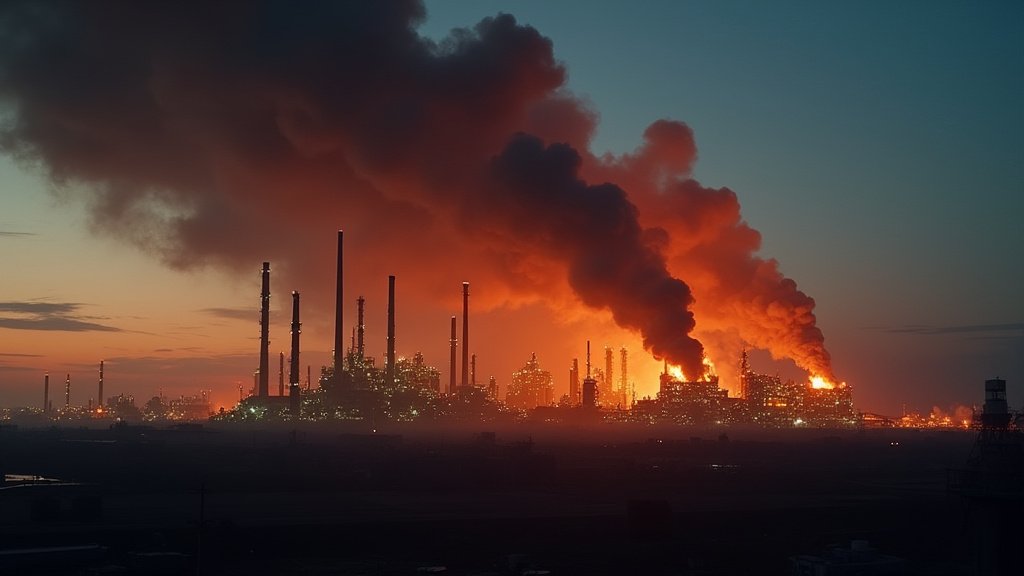
The most recent wave of attacks targeted the Ryazan refinery—Russia’s seventh-largest—and the Pervostroitel facility. Eyewitness footage from the scenes showed low-flying drones striking distillation columns with surgical precision, followed by massive secondary explosions and towering plumes of black smoke. Analysts suggest that Ukraine is intentionally targeting the ‘cracking’ towers, which are the most technically complex parts of a refinery and the hardest to replace due to Western sanctions on high-tech components.
Experts believe these drones, such as the ‘Liutiy’ (Fierce) model, are equipped with basic artificial intelligence that allows them to navigate via terrain mapping, making them highly resistant to electronic warfare. This technological edge has rendered traditional GPS-jamming tactics, frequently employed around Moscow and major energy hubs, largely ineffective.
Global Energy and Geopolitical Fallout
The international community is watching the escalating Ukraine drone strikes with growing apprehension. While Kyiv views these strikes as a legitimate response to the systematic destruction of its own power grid, the United States has reportedly expressed concerns. Washington’s primary fear is that a sustained disruption of Russian oil exports could lead to a global price spike, potentially impacting the domestic political landscape during an election year.
Despite these concerns, Ukrainian officials remain defiant. “We must strike the enemy where it hurts the most,” a senior security source stated. “Oil is the fuel of Russian aggression; without it, their tanks stop, and their treasury empties.” The economic impact is already tangible: the Kremlin’s decision to halt gasoline exports is a clear admission that domestic supply chains are under significant strain.
The Russian Response and Air Defense Gaps
Moscow has responded by intensifying its own missile barrages against Ukrainian cities, but the inability to stop the drones has exposed significant gaps in Russia’s domestic air defenses. Many of the S-400 and Pantsir systems originally designed to protect industrial hubs have been redeployed to the front lines, leaving the Russian interior vulnerable to the “swarm” tactics utilized by Kyiv.
As the smoke continues to rise from refineries in Samara and Nizhny Novgorod, the global community is forced to reckon with a new reality of modern warfare. The battlefield is no longer confined to the borders; it extends to every pipe, valve, and refinery that fuels the machinery of war.
FAQ: People Also Ask
Which Russian refineries have been hit by drones?
Significant strikes have been recorded at the Ryazan, Novoshakhtinsk, Syzran, and Slavyansk-on-Kuban refineries. These facilities represent a substantial portion of Russia’s domestic fuel production and export capacity.
How do these drone strikes affect global oil prices?
While Russia continues to export crude oil, the damage to refineries reduces its ability to produce refined products like gasoline and diesel. This tightening of the global refined product market, combined with investor uncertainty, has driven Brent crude prices toward the $90-per-barrel mark.
What technology is Ukraine using for these long-range strikes?
Ukraine is utilizing a mix of domestically produced UAVs, including the UJ-22 and the newer ‘Liutiy’ drone. These craft are designed for long-range endurance and are increasingly using autonomous terminal guidance to ensure accuracy even in environments with heavy GPS interference.